

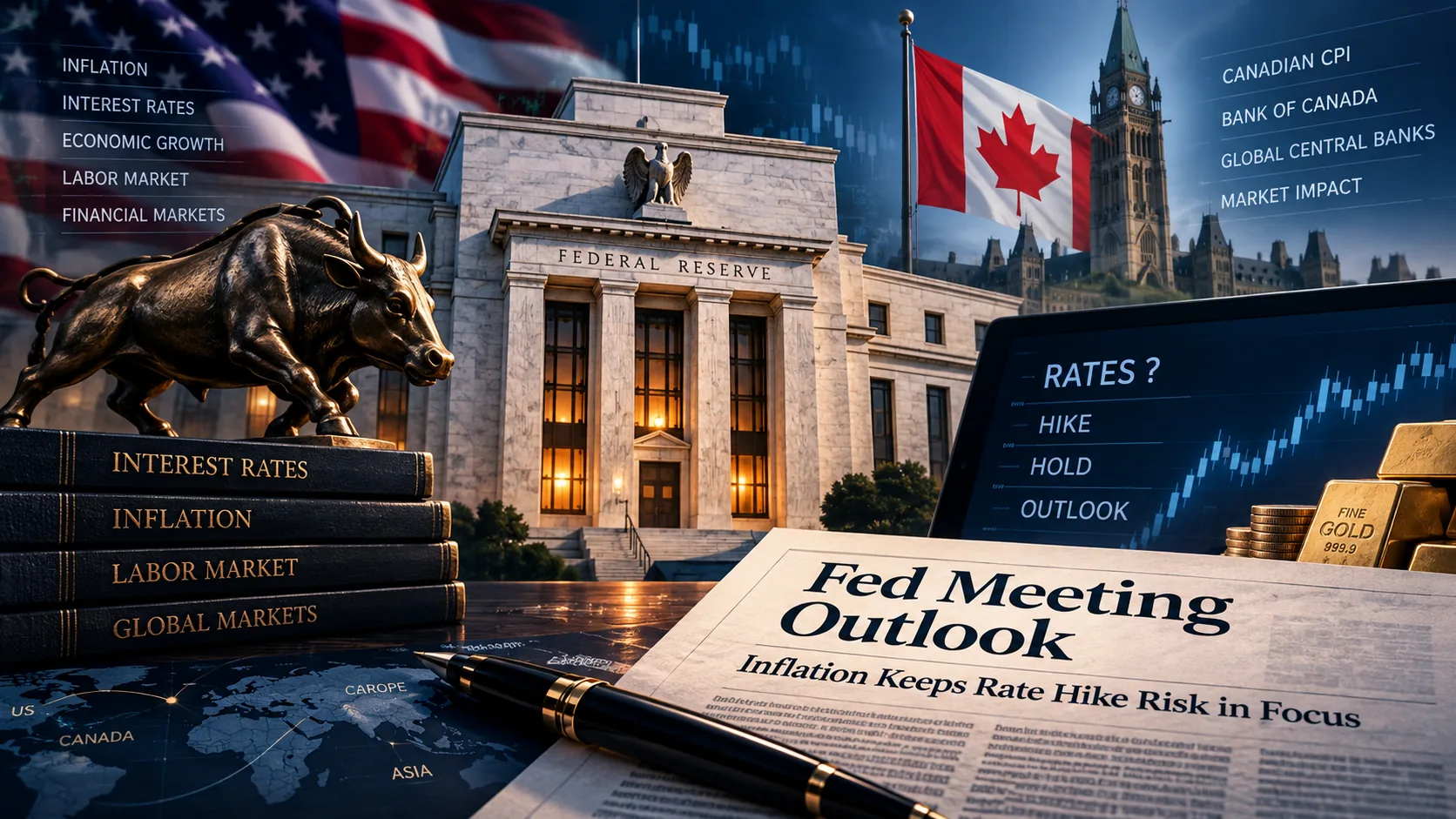
The Federal Reserve is heading into one of the most closely watched policy meetings of September as investors weigh persistent inflation pressures against the strength of the U.S. economy and labor market.
Recent inflation data have made the outlook increasingly complicated. Headline U.S. consumer inflation broadly matched expectations in August, but the monthly core reading accelerated, reinforcing concerns that underlying price pressures may not be cooling quickly enough.
That leaves financial markets facing a key question: Will the Federal Reserve keep interest rates unchanged, or has persistent inflation created enough pressure for another rate hike?
The answer could have implications well beyond U.S. monetary policy. Treasury yields, the dollar, equities, gold and global risk sentiment may all respond to how the Fed characterizes the balance between inflation and economic resilience.
At the same time, important inflation data from Canada and policy decisions elsewhere make this a broader test of the global interest-rate outlook.
August US Inflation Keeps Pressure on the Federal Reserve
The latest U.S. Consumer Price Index report delivered a mixed inflation picture.
Headline CPI increased 0.4% month over month and 3.4% year over year, broadly in line with economists’ expectations.
Core inflation, which excludes the more volatile food and energy components, presented a more nuanced picture. The annual core CPI rate eased to 2.4% from 2.5%, while the monthly reading increased to 0.3% from 0.2%.
The monthly core figure is particularly important for the Fed meeting outlook.
A single inflation report is unlikely to determine the Federal Reserve’s decision by itself. However, persistent monthly inflation can make policymakers less confident that price growth is moving sustainably toward the Fed’s longer-term 2% objective.
The distinction between annual and monthly inflation is therefore important.
Annual inflation can continue declining partly because of earlier price movements falling out of the comparison. A firmer sequence of monthly readings, however, could indicate that underlying inflation momentum remains stronger than policymakers would prefer.
Why a Fed Rate Hike Remains on the Table
The conventional case for another rate increase is relatively straightforward.
If inflation remains above target while employment and economic activity remain resilient, the Federal Reserve has more room to maintain restrictive monetary policy.
An additional 25-basis-point increase would take the federal funds target range to 3.75%–4.00%.
But the decision is not simply about whether current inflation is too high.
Policymakers must determine whether inflation is likely to remain persistent, whether existing monetary restraint is already sufficient and whether further tightening could create unnecessary pressure on employment and economic activity.
That makes the communication surrounding the decision especially important.
Even if the Federal Reserve leaves rates unchanged, a statement emphasizing persistent inflation risks and the possibility of additional tightening could still be interpreted as hawkish.
Conversely, a rate increase accompanied by more cautious forward guidance would not necessarily imply the beginning of a prolonged tightening cycle.
For markets, the future path of interest rates may ultimately matter more than a single 25-basis-point decision.
Inflation and the Labor Market Are Both Important
The Federal Reserve’s dual mandate means inflation cannot be considered independently of employment.
A resilient labor market can make it easier for policymakers to maintain restrictive rates because the economy may be better positioned to absorb higher borrowing costs.
However, evidence of meaningful labor-market deterioration would make additional tightening more difficult to justify.
This creates an important policy trade-off.
If inflation remains persistent while employment remains strong, the argument for maintaining higher rates becomes stronger.
If inflation moderates while labor conditions weaken, the balance could shift toward keeping rates unchanged.
Investors should therefore avoid interpreting the Fed meeting exclusively through the latest CPI figure.
Inflation, employment, wage growth, economic activity and financial conditions all contribute to the policy decision.
What Interest-Rate Markets Are Telling Investors
Market pricing ahead of a central-bank decision provides useful information, but it should not be treated as a prediction with certainty.
Different interest-rate instruments can produce somewhat different implied probabilities because of contract structures, liquidity and other market factors.
The more important signal is that investors remain divided over the next step in U.S. monetary policy.
That uncertainty can itself create volatility.
A more hawkish-than-expected Federal Reserve could put upward pressure on Treasury yields and potentially support the U.S. dollar.
A less hawkish outcome—or guidance suggesting that additional tightening is becoming less likely—could produce the opposite reaction.
These changes can then transmit into other markets.
Higher yields can pressure rate-sensitive equity valuations and increase the opportunity cost of holding non-yielding assets such as gold. Lower yields can ease some of those pressures.
The Fed meeting is therefore not simply an event for interest-rate traders. It has implications across global asset classes.
Canadian CPI Adds Another Test for Monetary Policy
Canada provides another important example of the challenge facing central banks.
Canadian inflation data are being closely watched as investors assess whether the Bank of Canada may need to maintain a restrictive policy stance.
Headline CPI is expected to remain around 3%, while the Bank of Canada’s preferred measures of underlying inflation are also receiving close attention.
Recent market pricing has shifted in a more hawkish direction, reflecting concerns that inflation could remain persistent.
But Canada’s economic picture is not uniformly strong.
Weak Canadian Employment Complicates the Outlook
Recent Canadian employment data provided a significant counterweight to inflation concerns.
Employment declined by slightly more than 40,000 in August, compared with expectations for an increase of around 15,000.
Much of the decline came from full-time employment, while annual wage growth also slowed.
That creates a difficult trade-off for the Bank of Canada.
If inflation remains elevated while employment weakens, policymakers must balance the risk of persistent price pressure against the possibility that additional tightening could place further stress on economic activity.
This is why the upcoming inflation data matter.
A stronger-than-expected underlying inflation reading could reinforce expectations that restrictive monetary policy may need to remain in place.
A weaker reading, particularly when combined with softer employment conditions, could strengthen the argument for keeping rates unchanged.
Why Expectations Matter as Much as the Data
Economic data do not move markets in isolation.
What often matters most is the difference between the actual result and what investors had already expected.
A relatively strong inflation figure may generate only a limited market reaction if investors were already positioned for it.
A seemingly modest downside surprise can have a much larger effect if markets had aggressively priced a hawkish outcome beforehand.
This principle applies to both the Federal Reserve and the Bank of Canada.
Investors are constantly adjusting expectations for future interest rates, and those expectations influence bond yields, currencies and asset valuations before central banks actually change policy.
Understanding what is already priced into markets is therefore an important part of interpreting economic releases.
A Major Week for Global Central Banks
The Federal Reserve and Canadian inflation are only part of a broader global monetary-policy calendar.
Markets are also monitoring important economic data from the United Kingdom as well as policy decisions from the Bank of England and Bank of Japan.
The details differ across economies, but the central question is similar:
How restrictive does monetary policy still need to be to contain inflation without creating excessive economic weakness?
The answer is becoming increasingly country-specific.
Some central banks may face persistent inflation alongside resilient economic activity. Others may confront weaker growth or employment before inflation has fully returned to target.
As a result, the global monetary-policy cycle may become increasingly divergent.
That divergence could become particularly important for currency markets, sovereign bond yields and international capital flows.
What Markets Should Watch Around the Fed Meeting
The headline rate decision will naturally attract attention, but several additional signals may be more important for understanding what comes next.
The Fed’s assessment of inflation persistence will be critical. So will its characterization of employment and economic activity.
Treasury yields should also be watched closely because they provide a real-time indication of how markets interpret the expected policy path.
The dollar can provide another signal.
If Treasury yields and the dollar rise together after the decision, markets may be interpreting the outcome as more restrictive than expected.
If both decline, investors may be concluding that the peak in policy restraint is closer—or that future tightening is becoming less likely.
Cross-asset confirmation can therefore provide more information than the immediate reaction in any single market.
Final Outlook
The upcoming Federal Reserve meeting is about more than whether policymakers raise rates by 25 basis points.
The larger question is whether recent inflation data have materially changed the expected path of U.S. monetary policy.
Persistent underlying inflation could justify keeping policy restrictive for longer, particularly if the labor market remains resilient.
But policymakers also have to consider the cumulative effect of previous tightening and the risk of placing unnecessary pressure on economic activity.
Canada faces a similar balancing act, with inflation concerns occurring alongside signs of labor-market weakness.
For investors, the most important signal this week may therefore be a change in the expected trajectory of interest rates rather than any single policy announcement.
That trajectory will help determine the next direction for Treasury yields, currencies, equities, gold and broader global risk sentiment.
Disclaimer
This article is provided for educational and informational purposes only. It reflects analysis of publicly available economic and market information and does not constitute investment, trading or individualized financial advice.
Farzad Vajihi
Financial Markets Analyst